Comprehensive post-editing of your machine-translated texts.

Comprehensive post-editing of your machine-translated texts.
Home » Translation » Post-editing
Post-editing of machine-translated content
Fully automated text translation is already common practice in many areas. The use of machine translations can be particularly helpful for large project orders. Post-editing is essential to achieve a flawless and contextually relevant result.

What is post-editing?
Post-editing refers to the process of revising or editing machine-translated texts by human translators. Machine translation, which is often created with the help of artificial intelligence and neural networks, is first generated automatically to speed up the translation process. However, machine translations are often not perfect and may contain errors, inaccuracies and stylistic inconsistencies that do not fulfil the precise specifications of the respective clients.
Post-editing is used when the quality of the machine translation must be ensured and improved. Our trained staff review the machine-translated text and adapt it to ensure a fluent, grammatically correct and technically accurate translation.
Do you require a revision of your machine-translated texts?
Our professional post-editing ensures linguistically correct, stylistically appropriate and target group-oriented translations – quickly, efficiently and in the highest quality.
Editing and proofreading of post-editing
In addition to post-editing, KERN also offers comprehensive proofreading services. Proofreading is essential to ensure that even machine-translated texts are stylistically fluent and accurate in terms of content. This service ensures that your texts are not only correct, but also persuasive and tailored to your target group.
Proofreading also helps to eliminate formal errors such as spelling, grammar and punctuation, thereby ensuring the quality of the final product. Even machine-translated texts benefit from careful proofreading to ensure maximum accuracy.

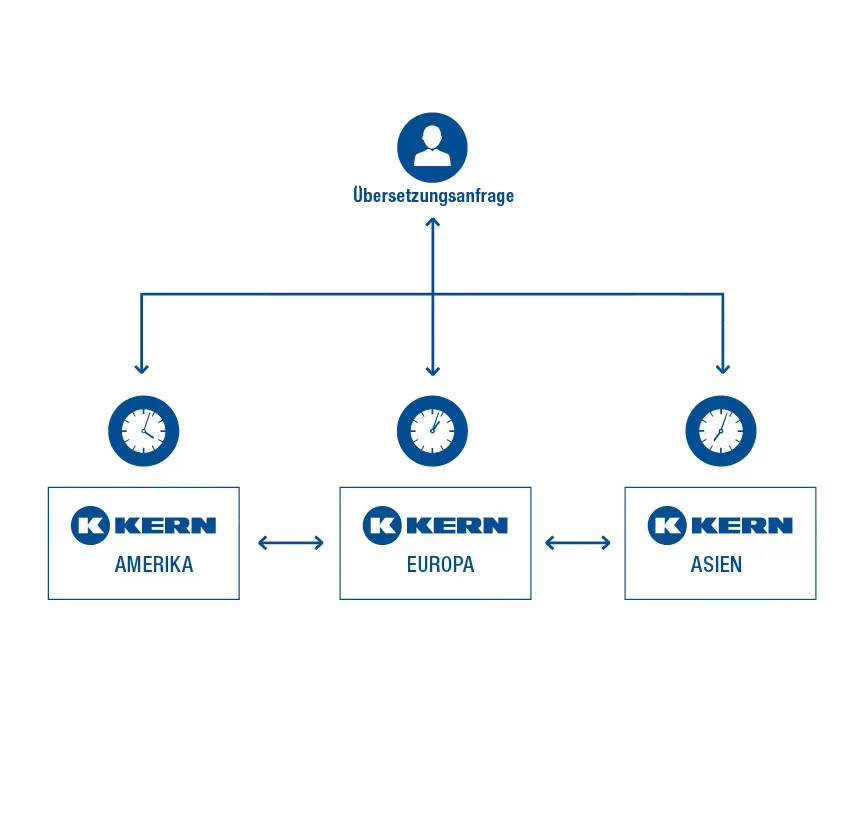
A finished translation in 24 hours
Our well-established processes enable us to deliver translations within 24 hours if required, and even within 30 minutes for particularly urgent projects. We will work with you to establish tailor-made processes to ensure maximum speed and quality.
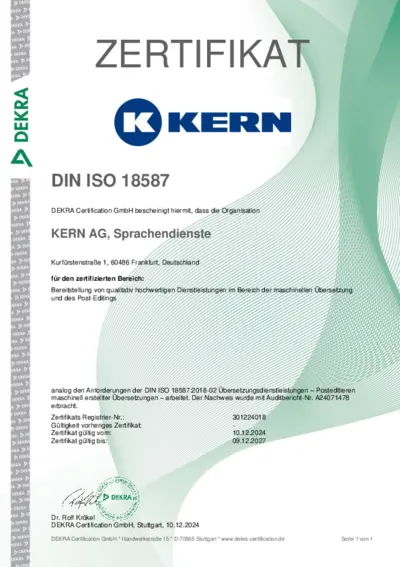
Certified in accordance with ISO 18587:2017
KERN is certified in accordance with ISO 18587:2017 for machine translation and post-editing. This is a certification from TÜV Hesse that we provide high-quality services for machine translation and post-editing. The wide range of machine translation systems available enables us to offer our clients an independent proof of quality, providing them with a means of comparison and the certainty that the machine translation and post-editing conform to a verifiable standard.
The standard defines important factors, including the individual work steps, the tasks, competencies and qualifications of the post editor. The post-editors use their expertise among others to optimise the machine-translated texts. Our machine-translated texts are post-edited based on clearly defined quality standards. The post-editing process is normally carried out via a translation memory system. Client-specific terminology requirements can be integrated as usual.
DIN ISO 18587
KERN provides high-quality services for machine translation and post-editing. KERN is certified for this in accordance with DIN ISO 18587.
FAQs about post-editing
You will find brief answers to the most important questions about post-editing here.
What is post-editing?
Post-editing is the revision of machine-translated texts by professional linguists. Errors are corrected and the linguistic quality is adjusted to the desired standards.
Which translations require post-editing?
Post-editing is primarily used for translations where accuracy is of the utmost importance. This applies in particular to texts such as catalogues, product descriptions and instructions, which are generally aimed at end consumers and must also bear the critical scrutiny of specific specialist circles. In these cases, a precise description of the functionality of the product is essential, both in terms of content and language, to ensure an overall picture that is accurate and communicated effectively.
There are many application areas of post-editing. In addition to the aforementioned texts for catalogues, product descriptions and instructions, it is also used in scenarios where a large volume of technical documents, emails, client reviews and other texts need to be translated. Post-editing enables companies to provide high-quality translations efficiently and cost-effectively, ensuring the required level of professionalism and comprehensibility for the respective international target group.
What services does KERN offer for post-editing?
KERN offers professional post-editing services to bring machine translations up to the required quality level. Our trained linguists optimise texts in terms of language, content and terminology and tailor them to the target group and intended use.
Whether marketing texts or technical documentation: We ensure clear, accurate and clear translations. The combination of machine translation and post-editing enables companies to save time and money without compromising on quality.
Why is post-editing necessary?
Machine translations provide rough drafts that may be stylistically, terminologically or grammatically inadequate. Post-editing ensures that the text is technically correct and reads smoothly.
What is the difference between post-editing and human translation?
In human translation, the entire text is produced manually by a specialist translator. In post-editing, machine translation serves as a basis, which is then revised.
What types of post-editing exist?
There are two forms:
- Light post-editing: Correction of major errors, focus on comprehensibility.
- Full post-editing: Stylistically and terminologically flawless adaptation to native speaker level.
How does the post-editing process work?
The process includes machine pre-translation, a review by qualified post-editors and a final quality check by the team of editors at KERN.
The post-editing is carried out by experienced language professionals with specialist knowledge in the relevant industry and expertise in working with machine translation systems.
What quality standards apply to post-editing?
KERN works in accordance with ISO 17100:2015 for translation processes. We also guarantee terminological consistency, technical accuracy and stylistic appropriateness in post-editing.
Is post-editing cheaper than human translation?
Yes, post-editing can be more cost-effective, particularly for large volumes of text or internal documents. However, the final costs depend on the quality requirements and type of text.
How long does a post-editing project take?
Post-editing is generally faster than traditional translations. The exact timeframe depends on the scope, language pair and degree of complexity.
Will my data be processed securely?
Yes. KERN implements certified security standards, encrypted data transfers and NDAs. Your information will be treated confidentially.
Can I choose between light and full post-editing?
Yes. We provide individual advice on which option is best suited to your requirements depending on the target group and intended use of the text.
Will machine translation eventually be able to dispense with post-editing?
Technology is advancing, but for professional communication, the human touch remains indispensable – particularly in sensitive specialist fields.