
Professional and legally secure patent translations

Professional and legally secure patent translations
Home » Translation » Patent translations
Patent translations in all languages
In the complex world of intellectual property, accurate and technically correct translations are essential in protecting and marketing innovations globally. KERN recognizes the critical importance of these requirements and provides high-quality translations for patent applicants, intellectual property departments, and patent law firms. Our service includes not only the translation of patent documentation, but also the careful adaptation to the specific legal and technical standards of each target country.
Are you interested in translating patents?
Feel free to contact us using the contact form, by phone, or book an online meeting.
We look forward to hearing from you!
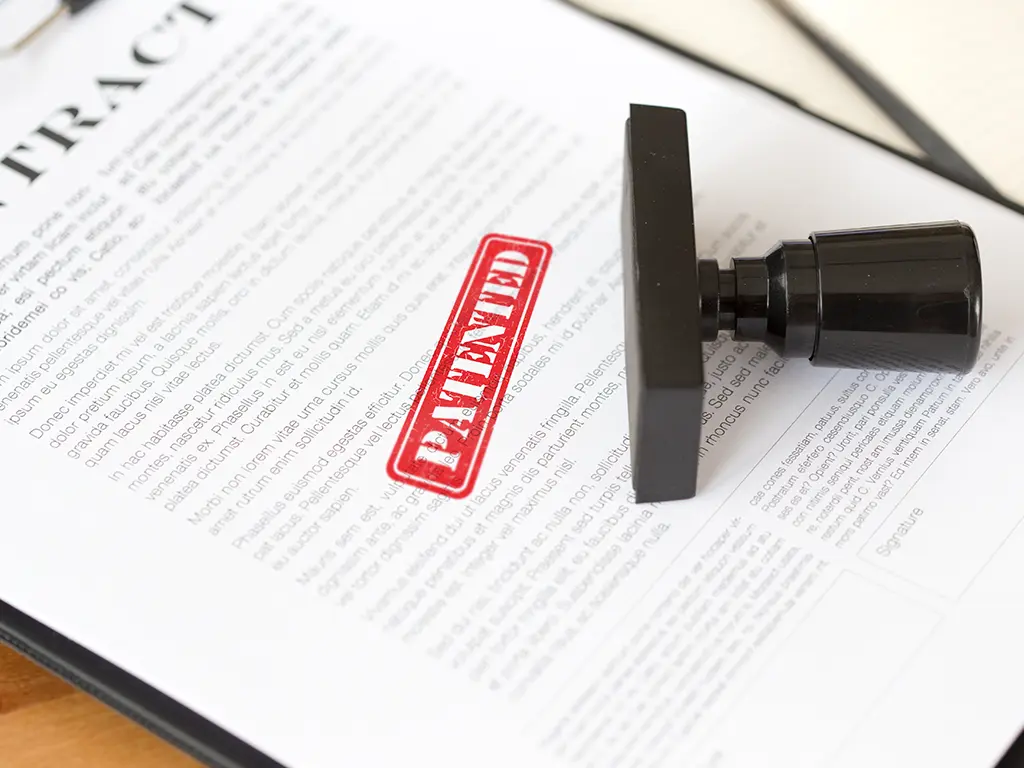
Multilingual patent translations with technical expertise
Whether you need a precise translation for an international patent in English, German, French or another language – KERN covers a wide spectrum. With a team of experienced translators who are knowledgeable in various technical and scientific fields, we provide multilingual translations while ensuring maximum accuracy, consistency and terminological precision.
Our comprehensive language services include the taking into account of all the nuances and subtleties necessary for the successful patent application and defense in different legal systems.
A finished translation in 24 hours
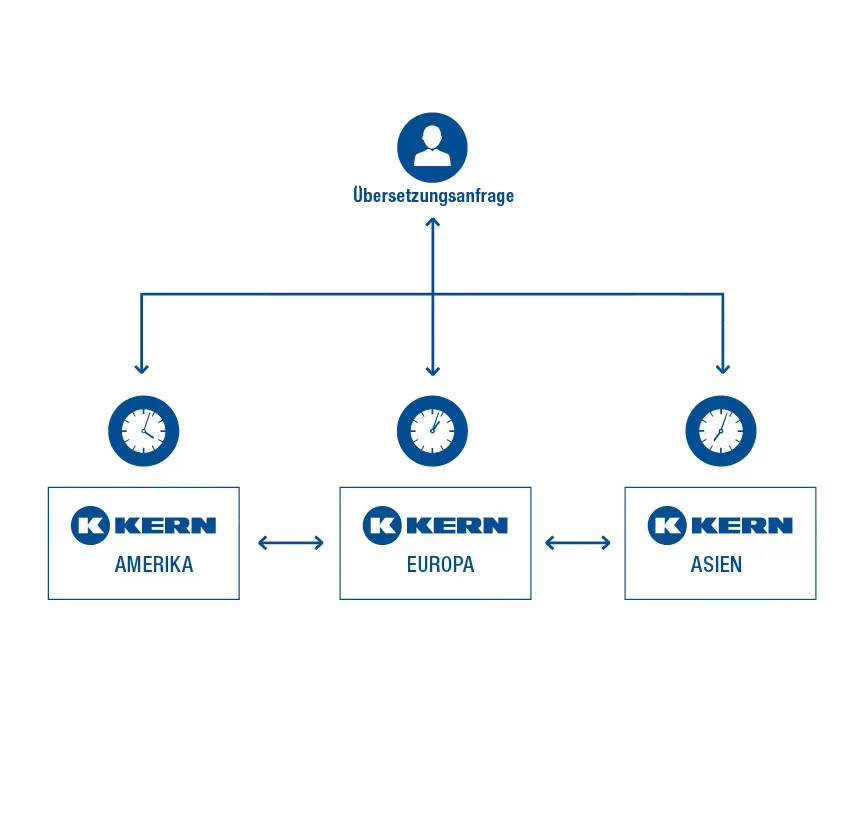
Thanks to our well-established processes, we are able to deliver translations within 24 hours if required – and for particularly urgent projects, even within 30 minutes. Working together with you, we establish tailor-made processes for maximum speed and quality.
Professional patent translations by KERN
Accuracy and terminological precision are essential in the translation of patent documents. Even the smallest translation errors can have serious consequences for the application, enforcement or use of a patent. In this highly sensitive area, it is not only a question of correct syntax and punctuation, but above all of using exact specialist terminology to ensure the clarity and legal unambiguity of a patent in any target language.

Your patent project – professionally managed from start to finish
At KERN, your patents are in safe hands. We understand the importance of discretion and confidentiality in patent translation and undertake to handle your documents and information with the utmost care and security. Our services include legally secure and high-quality patent translations in a wide range of languages. In order to demonstrate our competence and reliability, we are happy to offer you a non-binding and free offer.
You can rely on the expertise of KERN to promote international recognition and enforcement of your patents.
We help you overcome language barriers and make your innovative ideas accessible worldwide by ensuring the integrity and protection of your intellectual property rights in an ever-changing global context.
For further information or a personalized quote, please feel free to contact us at any time using our contact form or by phone.
FAQs about patent translations
You will find short answers to the most important questions about patent translations here.
Which specialist areas does KERN serve in patent translations?
At KERN, we cover a wide range of specialized areas of patent translations in order to meet the diverse requirements of our customers. Our expertise spans numerous technical fields, including:
- Electrical engineering: We provide precise translations of patents in the field of electrical engineering concerning innovations in electronics, electromechanics and electrical systems.
- Mechanical engineering: Our team specializes in the translation of patent documents dealing with innovations in the design, development and production of machines and mechanical systems.
- Telecommunications: In this fast-moving sector, we translate patents that focus on the latest developments in transmission technology, network infrastructure and communications equipment.
- EDP (electronic data processing): We master the complex terminology of EDP and ensure accurate translations of patents dealing with data processing systems, hardware and their applications.
- Software: The translation of software patents requires a deep understanding of programming languages and software architectures, which we ensure through our specialized translators.
What services does KERN offer in the area of patent translations?
KERN offers a comprehensive portfolio of services in the field of patent translations to meet the specific requirements of our customers. Our services include:
- Use of patent-specific technical language: We guarantee the correct application of the specific terminology required for the respective patent application in order to ensure the precision and legal validity of your patents.
- Content structure of patent specifications: Our experts are familiar with the structural requirements of patent specifications and ensure a correct reproduction of the content structure in the target language.
- Vocabulary of the respective patent class: Each subject has its own specific vocabulary, especially in the different patent classes. We ensure that the correct vocabulary is used to maintain the uniqueness and validity of your patents.
- Layout creation and editing of patent drawings and specifications: In addition to the text translation, we also take care of the visual aspects of your patent specifications, including the professional processing and adaptation of patent drawings.
- All disciplines: Our range of services covers all relevant technical and scientific disciplines, including electrical engineering, mechanical engineering, telecommunications, EDP and software, to name but a few.
- Patent translations in all languages: With a global network of specialized translators, we offer patent translations in almost any language to support your international protection and presence.
Through these comprehensive services, KERN ensures that your patents are accurately translated not only linguistically, but also in terms of content and visual appearance. In this way, you can rely on your innovations to be protected and recognized worldwide.
Is it possible to certify the patent translation?
If certification of your patent translation is necessary, KERN offers suitable solutions. We can ensure certification by a sworn translator or issue a so-called Translator’s Certificate, depending on the requirements of your target country and the corresponding patent office. A certified translation of your patent application ensures the official recognition of your document and its deployability in legal contexts. Certification also confirms the authenticity and precision of the translation, which minimizes the risk of misunderstanding or legal difficulties. With the expertise and comprehensive services of KERN, your patent documentation will be professionally and reliably certified.
What are the requirements for translating a patent?
The translation of a patent requires specific requirements that go beyond the usual linguistic competence. An essential prerequisite is a thorough understanding of the legal framework, especially the patent system, within the respective legal system. This body of legal experience must be combined with a high level of technical or scientific expertise in the field of patents in order to accurately translate both the legal and the technical aspects.
In addition, a patent translation requires adherence to specific formal requirements and rules, which may vary from legal system to legal system. A prominent example of this is EU requirement rule 51 of the European Patent Convention (EPC), which provides detailed guidance on the form and content of patent applications. In addition to such rules-based requirements, the stylistic conventions and the specific vocabulary of the respective patent class must also be taken into account in order to ensure the unambiguity and legal validity of the patent in the target language.
Meeting these complex requirements requires not only linguistic expertise, but also an interdisciplinary understanding and the ability to express oneself precisely in the respective fields. Patent translators must therefore be able to both understand and correctly translate complex technical concepts and legal subtleties. KERN ensures that these requirements are met in every patent translation in order to support the protection and international recognition of your innovations.
What qualifications do patent translators have?
KERN Global Language Services’ patent translators are characterized by an exceptional level of expertise and qualifications. They are not only experienced professionals in their respective technical or scientific fields, but also have a sound legal background that is specifically geared to the requirements and complexities of patent documentation. Many of our translators are themselves engineers or scientists who have studied the world of patents intensively and therefore have a deep understanding of the subject matter.
In addition to their technical expertise, our patent translators are trained in the intricacies of patent terminology and are always up to date with developments in their field of expertise and the corresponding legal framework. This allows them to produce accurate and legally compliant translations that meet the needs of patent offices worldwide. The combination of technical know-how, legal understanding and linguistic precision ensures that your patents are translated correctly to ensure the best possible protection and recognition of your inventions and intellectual property rights.
What are the requirements for patent translations?
Patent translations must demonstrate a high degree of linguistic accuracy and consistency. It is important that all technical details and concepts contained in the patent are translated accurately to avoid potential misunderstandings. In addition, translations must meet the specific requirements of the patent authorities in the target countries.
How much does a patent translation cost?
The cost of patent translation varies depending on the length of the patent, technical complexity, language combination, and the translation service provider selected.
Please feel free to inquire about your project. We advise you on the requirements, necessities, and scope of your patent translation.
What documents do you need for a patent translation?
The most important documents for a patent translation are the actual patent specification, which describes the invention itself, its technical background, its execution and design, and the patent claims. These must be translated as accurately as possible in order to protect your invention to the same extent in every country.
How long does a patent translation take?
The duration of a patent translation depends on various factors, such as the length of the patent, the complexity of the technical information, and the requirements of the target authorities. A precise time frame can only be given after examining the exact scope of the patent.
However, you can request an urgent translation from KERN at any time. All KERN translation agencies offer express translations – within 24 hours if required.
Does a patent have to be translated into every language in which the patent is valid?
Within the EU, it depends on the specific patent and on the question of which member states it should apply in. In principle, it is sufficient for the entire territory of the European Union to translate a patent into the three official languages German, English, or French.
What are the special features of patent translation?
A patent is a complex and demanding document that is also integrated into a legal framework. Patent translation requires not only a thorough knowledge of the relevant technical terminology, but also an extremely meticulous approach to work with a strong focus on attention to detail. The patent translation must also be adapted to the regulations and standards applicable in the target country, observing explicit formal requirements as well as traditionally desired content structures. Nevertheless, the actual content of the patent must not be changed.