
Home » Translation » Translation processes
Setting up and optimizing translation processes
Does your company regularly require a large number of translations? That makes it necessary to establish an optimized translation process. A well-structured translation process improves output quality, and can lead to significant time and cost savings.

Translation process requirements
Translations are needed for more and more target languages, time-to-market is becoming ever shorter and the document and system structures are becoming more complex. The management of translation processes and projects is becoming increasingly important. The demands placed on localization service providers are also constantly evolving.
We also support companies in the medical technology and pharmaceutical industries with industry-specific translation and localization for technical documentation, regulatory documents, and more.
Why translation projects require customized processes
Years of experience have shown us that client is unique. While there are similarities, each has its own way of doing things. Even teams that use the same translation tool might use its features differently. This is because they are each working with different requirements, targets, budgets, stakeholders, and framework conditions.
It is therefore important not to view translation projects as isolated tasks for individuals. They are in fact a process, one that is part of an integrated whole made up of upstream and downstream workflows. Translation management is often necessary in order to meet all requirements. A high degree of specialization and adaptation to customer needs has become indispensable.
Would you like to streamline your translation processes?
We analyze and optimize your translation processes – for higher quality, shorter turnaround times, and lower costs for recurring projects.
Customized translation processes for your company
KERN specializes in setting up and optimizing customized translation processes. Our customized solutions meet your needs and give you a competitive advantage in the global marketplace.
To ensure efficiency and consistency, KERN invests considerable time in the configuration and optimization of translation processes. We also understand the need for flexibility when it comes to offering a wider range of services, and building close relationships with our corporate clients.
Our goal is to work with you to develop flexible, tailor-made translation processes that pool the company’s in-house knowledge to your best advantage.
- Advice in the field of translation-ready writing and formatting
- Obtaining, correcting, and maintaining client-specific terminology
- Building up and maintaining translation memory databases
- Seamless integration of customized processes into a comprehensive workflow
Our project managers work closely with you to understand your specific requirements. Whether you require a high level of standardization to reduce costs, or prioritize flexible workflows.
A finished translation in 24 hours
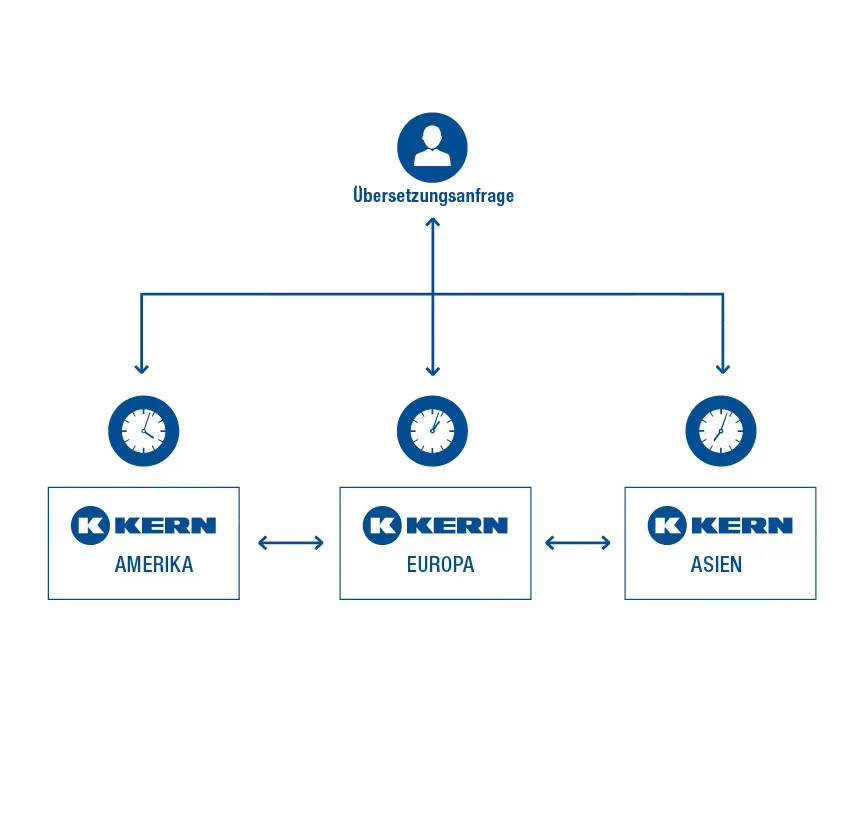
Thanks to our well-established processes, we are able to deliver translations within 24 hours if required – and for particularly urgent projects, even within 30 minutes. Working together with you, we establish tailor-made processes for maximum speed and quality.
Document-based translation processes
A document-based translation process is a proven method for ensuring quality and consistency. At KERN, we rely on many years of experience and comprehensive know-how in the area of document-based translation. Our team of qualified specialized translators guarantee that your documents are translated into the desired target language in an accurate and comprehensible manner.

Advantages of traditional document-based translation
- Highest precision: Manual translations guarantee adherence to technical terminology and linguistic nuances.
- Confidentiality and security: Your sensitive data is safe with us. We adhere to strict data protection guidelines.
- Customization: Each translation is tailored to your requirements and the specific context.
Approach taken to document-based translations
We analyze your documents and prepare a customized quote.
Experienced project managers coordinate the entire translation process.
After translation, our editing team conducts a thorough review.
You will receive the finished translation on time and can provide feedback whenever you wish.

AI-supported processes with workflow orchestration
AI-supported translation processes offer a modern solution for making translations faster and more efficient.
At KERN, we already use advanced AI technologies and workflow orchestration to deliver highly accurate translations. These processes combine machine learning with human expertise to achieve optimal results.
Benefits of an AI-supported translation process
AI-supported processes enable faster processing of large volumes of documents.
Automation allows us to reduce costs and pass on savings to our customers.
AI models ensure consistent terminology and style.
Language service provider with tradition and innovative strength.
Native-speaking specialist translators in over 100 languages.
Approach to AI-supported processes
We assess the scope and requirements of your translation projects.
Our AI models handle the first phase of translation.
Our specialized translators refine the machine translations and ensure quality.
The entire process is controlled by a robust workflow management system to ensure efficiency and transparency.
Automated processes and connection of client systems
Automated translation processes and the integration of client systems can be decisive factors when it comes to competitiveness.
KERN offers advanced automation solutions and customized system connections to accelerate and optimize your translation processes.

Advantages of automated processes
- Time savings: Automated processes significantly reduce processing time.
- Increased accuracy: Minimization of human error through automation.
- Easy integration: Seamless connection to existing systems such as CMS, PIM, and ERP.
Our approach to automated processes
We analyze your existing systems and identify integration opportunities.
Our engineering team implements the automated processes and integrates them into your systems.
We carry out extensive testing to ensure that everything run smoothly
We train your team and offer ongoing support to ensure optimal use of all systems.
More information about our translation processes
Developing editorial guidelines together provides a useful resource for both internal and external teams. The guidelines contain all the internal directives and stipulations that those involved in the creation of the documents must observe.
These cover linguistic specifications on terminology and syntax, as well as design specifications such as typography, layout and the use of graphics. Aspects of corporate identity such as logos and in-house fonts must also be taken into account. As well as areas of responsibility.
As a result, the documents created are not only more consistent but the company’s overall public image becomes characterized by reliability.
An efficient translation process is a key component of the client-oriented project management at KERN. From arranging orders to maintaining language databases, our project managers will create a detailed project schedule together with you.
At the start of a translation project, a dedicated project manager will be assigned to you. They will keep you informed about the status of your project at all times. The project is planned, the costs are estimated and all aspects to be coordinated are taken into account.
The project manager responsible for your project will coordinate the entire translation project with you and our specialized translators, editors, graphic designers, etc.
As a client, you can even help us in advance to ensure that we carry out your
translation order to your complete satisfaction.
Plan ahead
The processing time for a translation depends on the following parameters:
- Length of the text
- Level of difficulty of the text
- Desired language combination
- Quality of the manuscript
Please bear in mind that a professional specialized translator can translate a maximum
of 10 to 15 pages per day, on average. Difficult texts and rare languages require more time.
When choosing your desired delivery date, please consider the increased workload and time required for additional work, e.g. for adaptations, proofreading, foreign-language typesetting, editing, graphic design, printing, etc.
Please provide all relevant details when placing your order
- the desired language combination
- for which country the translation is intended
- whether the translation should be certified by a sworn translator
- whether the translation is to be published
- any requests in terms of formatting and conversion, as well as which end product you require
Translation support
You can provide KERN with translation support such as glossaries, reference materials, and parallel texts. This assists translators in producing specialized translations and enables them to work more efficiently.
Translation composition
The translation process does not begin when the documents are handed over to KERN, but rather when the documents are created. When creating a document in the source language, you can avoid potential translation problems by using wording that is easily translatable. Texts where the possible translation was not taken into consideration often result in:
- significant effort for the translator to understand the subject matter,
- for example through additional research, and
- higher translation and layout costs due to expensive correction and formatting work.
Moreover, source documents that are suitable for translation facilitate the efficient use of translation software such as translation memory systems. Last but not least, the time taken to process and create your multilingual documents will be significantly reduced.
In the creation process, a document should be phrased and designed in as culturally neutral a manner as possible. This includes formalities such as the use of culture-neutral non-verbal language. For example, internationally recognized pictograms and the large-scale avoidance of the use of idiomatic expressions. Furthermore, you have to bear in mind that the target text can become considerably longer than the source text with certain directions of translation.
Rule suggestions
When creating your documents, the rules that you should observe for translation-ready writing can be summarized as follows:
- Language-neutral formatting
- A defined meaning for every word
- No use of synonyms for technical terminology
- Explanation of new terms and abbreviations
- No filler words, no complex sentence structures, support direct requests through syntax
- Adherence to a logical order (first cause, then effect)
- Present tense
- One call for action per sentence
- Use of culturally neutral illustrations
The highly qualified KERN translation team has many years of experience in translating texts from one language into their own native language. This facilitates smooth translation management.
KERN translator backgrounds in terms of training and experience:
Education:
- Training and qualification as a translation graduate with a university education in foreign languages (4 to 5 years)
- Linguist with a university education in one or two foreign languages (4 to 5 years)
- BA or MA degree
- State-approved or accredited translator (state examination, 2 to 3 years)
Practical experience:
- Translation experience of at least 4 years
- Specialization in one or more areas of expertise (e.g. economics, technology, law, etc.) A detailed list of the areas of expertise can be found here.
- Certain translators have taken an oath before a court and may certify translations
- Further training in the use of software and tools
KERN’s specialized translators only work into their native language:
KERN’s founding principle for over 50 years
Establishing customer-specific translation processes
KERN’s translation team optimizes your entire translation workflow with individual translation processes. You can download our info sheet “Developing client-specific processes” here.