
Global communication – customized for every language and industry.

Global communication – customized for every language and industry.
Home » Translation » Localization
Localization in every world language
Localization is the key to successful international communication. It goes beyond mere translation and takes into account the cultural, linguistic, and technical characteristics of each target market. KERN helps companies localize content effectively for specific target groups, in every world language. Whether you need software localization, website localization, or localization of marketing materials or technical documentation, we offer solutions that make your messages understandable worldwide.

Localization with KERN: Your advantages
Working with KERN offers you numerous advantages to ensure your success in international markets:
- Experience and expertise: For over 50 years, we have been supporting companies with their global communications.
- Wide range of languages: Translations and localizations into more than 100 languages.
- Customized solutions: Tailor-made services that are perfectly suited to your needs.
Are you interested in localization?
Please feel free to contact us using the contact form, by phone, or book an online meeting.
We look forward to your request!
The localization process at KERN
The localization process at KERN is designed to ensure maximum efficiency and quality. This detailed overview of our localization process shows how we work to enable global success.
We conduct a comprehensive needs analysis and use it to develop an efficient project workflow as well as customized localization and translation strategies.
We prepare all content technically, make it machine-readable, and, if necessary, create subtitles, voice-overs, or dubbing for video content.
The content is machine translated and then optimized by native-speaking experts, taking linguistic and cultural characteristics into account.
For software-related or e-learning projects, we translate the interface and adapt eachelement for seamless use in the target language.
Finally, our linguists check all content for linguistic accuracy, consistency, functionality, and cultural relevance in accordance with ISO standards.
Professional e-learning translations and localization
If you want your online training program to be internationally successful as well, a simple translation is not enough. Different languages, cultural characteristics, and technical requirements need to be specifically taken into account.
That is why e-learning localization goes beyond translation: it adapts your content linguistically, culturally, and technically to the respective target group—from texts and images to formats, units of measurement, and dates. This ensures your learning content is understandable, relevant, and effective worldwide.

Which e-learning elements need to be localized?
In addition to traditional text, modern e-learning platforms also use media files such as images, audio, animations, and videos. Each of these elements requires a different approach to localization, and KERN AG offers the right solutions for each.
- Interface for the e-learning platform
- text localization
- Images and graphics
- Multimedia and video localization
- Voice-over localization
- Video subtitling
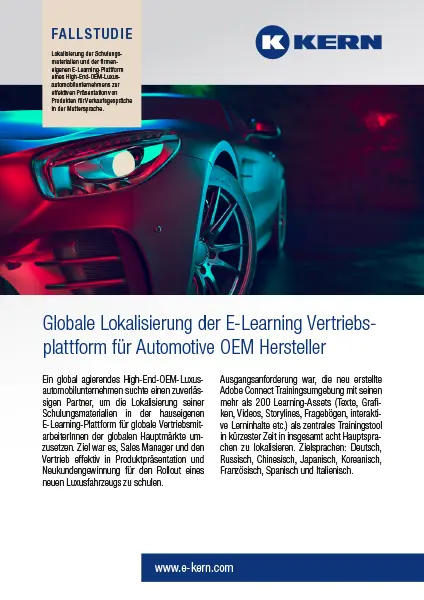
Global localization of the e-learning sales platform for automotive OEM manufacturers
Read our case study to learn how KERN successfully implemented global localization of an e-learning sales platform for an automotive OEM manufacturer.
Software localization by KERN Global Language Services
With professional software localization, KERN ensures that applications are understandable, user-friendly, and marketable worldwide. In addition to translating user interfaces, menus, error messages, and documentation, we also take cultural and regional requirements into account, such as date formats, currencies, and country-specific conventions.
A particular focus is on translating SAP systems. Our language and IT experts carefully localize SAP modules, interfaces, reports, forms, and training materials for international use. That helps companies use their systems efficiently, improving collaboration among global teams and optimizing processes across locations.

FAQs about localization
Here you will find answers to frequently asked questions about our localization services.
What is the difference between localization and translation?
Localization involves adapting content to the linguistic, cultural, and technical characteristics of a target market. It goes beyond mere translation by also taking cultural nuances, local formats, and technical requirements into account.
Why is localization important for businesses?
Localization enables companies to effectively address their target groups worldwide, overcome cultural barriers, and gain the trust of international customers.
What is adapted during localization?
In addition to translating texts, formats (e.g., dates and currencies), images, symbols, and design elements are also adapted to the cultural and technical requirements of the target audience.
When does content need to be localized?
Content should be localized when companies want to tap into new markets, address target groups in different countries, or adapt products and services to international requirements.